Last week was a crazy week with Microsoft going down and planes being grounded. We were lucky enough to spend the week in Anna Maria Island, Florida, at a friend’s timeshare. Beautiful beaches, beautiful sunsets, and the Crystal Classic sand sculpture contest at Siesta Key were definitely highlights. Our flight home was unfortunately canceled. We wanted desperately to get home as our son was home for a visit so we decided to drive home to Connecticut. 18 hours later - we made it and honestly it wasn’t terrible.

Sunrise on our drive home, a fishing boat at sunrise, and happy colored houses.
Siesta Key Sand Sculptures
My favorite sand castle was “What Gets In” by Matthew Deibert, which took second place. It’s a giant head with its eyes closed and the top open to a brain, surrounded by a phone, a padlock, books, a clock, pills, and a broken heart. Walk around it and one side is a giant ear with a tiny figure standing inside. We spoke to Matthew as he was creating. He talked about the many influences on children - music, technology, medicine, etc. What we hear shapes what we think, the good influences and the bad, from music and screen time to friends and the people guiding us. It stayed with me all week, especially while the technology we lean on kept failing.
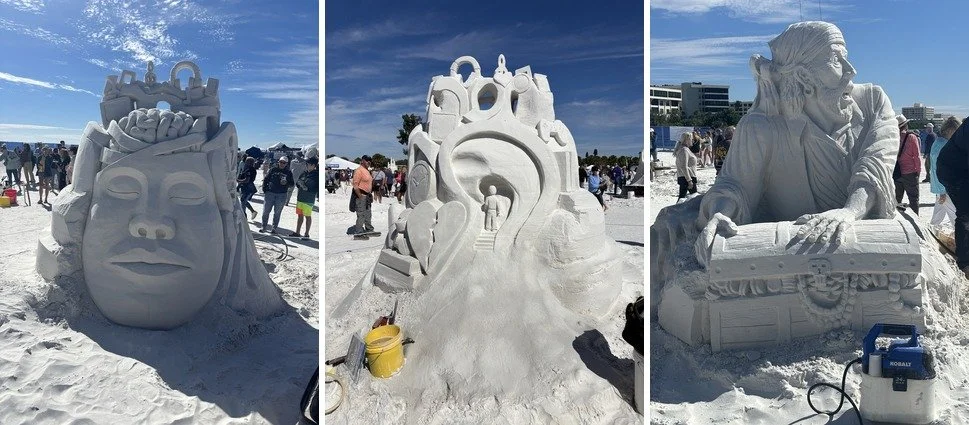
Sand sculptures at Siesta Key: What Gets In, front and side, and Surrender the Booty
First place went to “Surrender the Booty” by Brian Wigelsworth: a pirate leaning over a treasure chest, with an alligator coming up behind him.
Tools
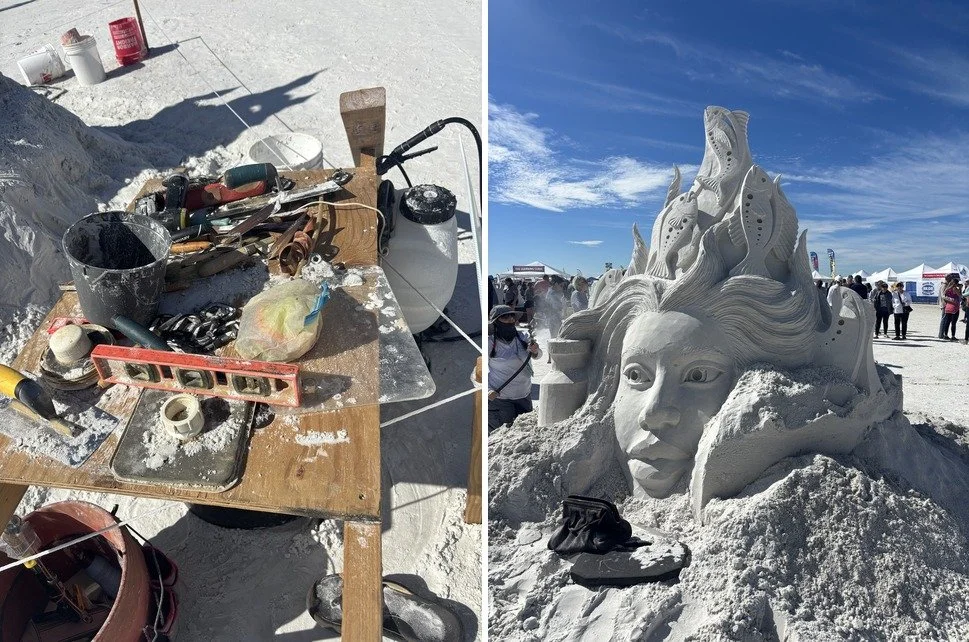
Every one of those sculptures came from a few simple tools used well to create a breathtaking piece of work. Trowels, levels, buckets, spray bottles were always close at hand. Each sculptor had their favorite tools - the ones that fit best in their hand, and worked best for the type of building or carving they did.
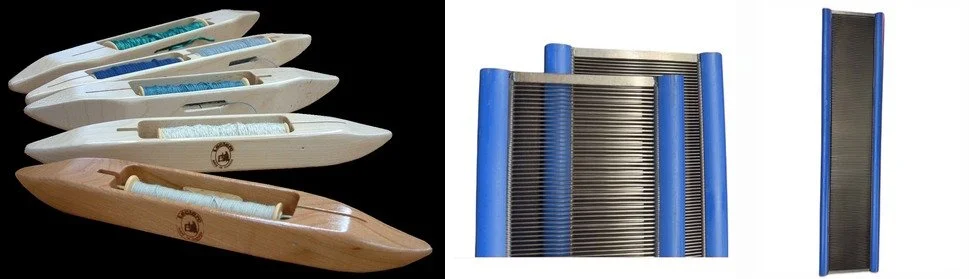
Weaving is the same. Back at the loom, two tools do the quiet work in every project: the reed and the shuttle. Both are now in the shop from Leclerc.
Shuttles
The shuttle carries your weft across the shed, and the right one depends on your loom, your yarn and you.
Canadian maple boat shuttles, in five sizes: Slim and Small for table looms and lighter yarns, Regular for everyday floor looms, Large for a 6 in bobbin and wide warps, and Double-Bobbin for two wefts at once. Each includes a styrene bobbin. My favorite is an open bottom shuttle because I can manipulate the tension of the bobbin with my index finger.
Flat stick shuttles, in 6 and 14 in: for rigid heddle looms, sampling, and pick-up work. The knife-shaped edge beats the weft into place.
End-feed shuttle: feeds the weft through an adjustable tension device at the tip, so every pick lays in at the same tension and your selvedges stay even. It works best with smooth, plied yarns like 8/2 cotton. A wood pirn is included.
Shuttles are in stock and ship same day or next day, so you can get back to your weaving.
Reeds
The reed is the comb-like frame in your beater that spaces the warp threads and beats each pick into place.
Standard height: 4.75 in outside, 3.5 in inside
Widths from 9.5 to 60 in; 6, 8, 10, 12, and 15 dents per inch
Stainless steel won’t rust in a humid studio, and the polished dents snag less
Standard sizes ship within 5 days, no quote needed
They fit looms other than Leclerc if your beater slot is about 4.75 in high
Need the taller 5.25 in outside / 4 in inside version, another width, or another dent count? Special orders always welcome. Reach out and I’ll get you timing and pricing.
We can also source custom reeds if the Leclerc reed options don’t work for your loom.
Next time you pick up your shuttle, think of those sculptors: whether in sand or on the loom, the right tool in your hand makes the work go better.
As always,
Happy Weaving,
Mary Ann